
There’s a kind of tired that sleep doesn’t fix.
A tension you carry in your shoulders that never fully releases. A tightness in your chest that shows up out of nowhere. A feeling of being stuck — not lazily stuck, but stuck in a way that makes no logical sense.
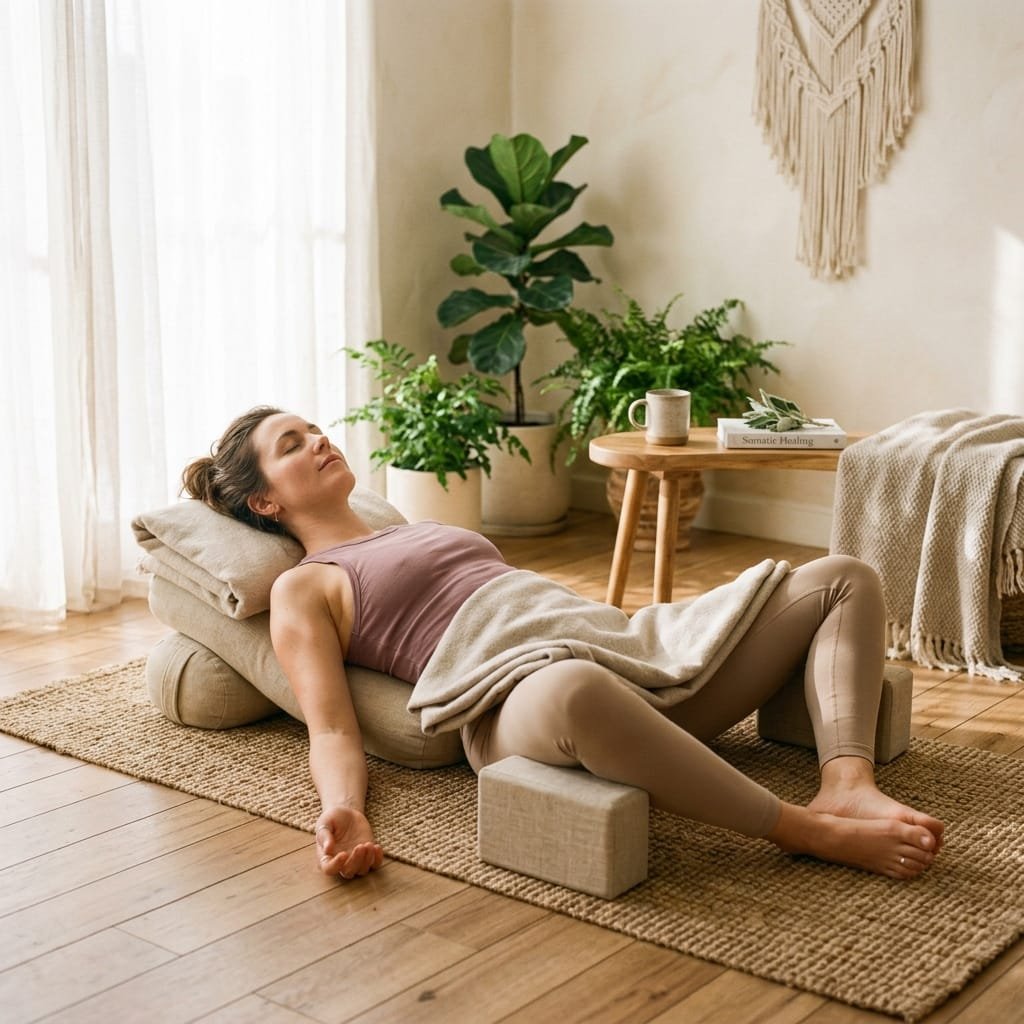
That might not be in your head. It might be in your body.
Trauma doesn’t always look like a dramatic event. Sometimes it’s the slow accumulation of stress, grief, emotional overwhelm, or years of pushing through things you never got to process. And your body — loyal, patient, incredibly wise — holds all of it.
Somatic exercises are one of the gentlest, most effective ways to start releasing what your body has been quietly carrying. No talking required. No reliving anything. Just you, your breath, and your body finally getting permission to exhale.

What Are Somatic Exercises, Really?
Somatic exercises are slow, intentional body movements designed to bring your attention inward — not to push harder or get stronger, but to notice what’s there.
The word “somatic” comes from the Greek soma, meaning body. Unlike yoga or pilates (which focus on flexibility and strength), somatic movement is entirely about awareness. You’re not trying to achieve a pose. You’re trying to feel what’s happening inside it.
Think of it as a conversation with your body instead of a command.
They’re rooted in somatic therapy — a healing approach that works with the body to address stored trauma and nervous system dysregulation. Research from Harvard Health describes somatic therapy as a practice that explores how the body expresses deeply painful experiences, applying mind-body healing to support trauma recovery.
This isn’t fringe wellness. It’s becoming one of the most evidence-backed tools for emotional healing — and the beautiful thing is, you can do it from your bedroom floor.
Why Trauma Lives in the Body (And Not Just the Mind)
You know that jaw-clenching thing you do when you’re stressed? Or how your shoulders creep up toward your ears when you’re anxious?
That’s not random. That’s your nervous system doing exactly what it was designed to do — protect you.
But when stress and trauma go unprocessed, those protective patterns don’t just switch off. They become chronic. Tight hips. A stiff neck. Digestive issues. A racing heart for no reason. Your body isn’t being dramatic — it’s telling you something got left behind.
The hips especially tend to hold a lot. Many somatic therapists describe this area as one of the body’s primary stress storage zones — connected to walking, breathing, and digestion. If you’ve ever felt emotional during a deep hip stretch, now you know why.
Your nervous system remembers what your mind tries to move past.
The 10 Best Somatic Exercises to Release Stored Trauma
These aren’t intense. They’re not meant to be. The goal is presence — not performance.
1. Body Scan Meditation
This one asks nothing of you except to arrive.
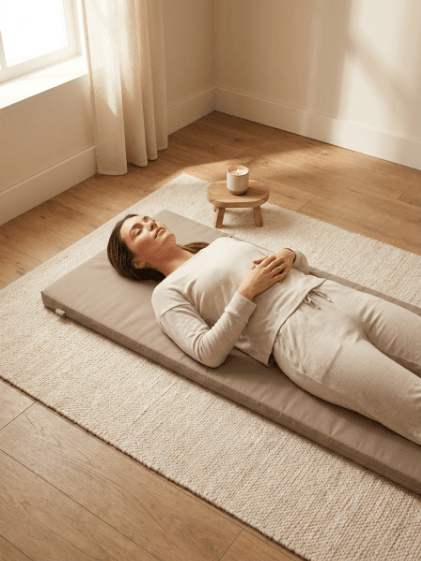
Lie down somewhere comfortable. Close your eyes. Starting at your feet, slowly move your attention up through your body — ankles, calves, knees, hips — noticing anything that feels tight, numb, or heavy. You’re not trying to fix it. Just notice.
When you find a spot that holds tension, breathe into it. Slowly. Like you’re sending warmth there.
It sounds simple, and it is. But most of us spend so much time living from the neck up that even five minutes of this can feel like coming home.

2. Diaphragmatic Breathing (Belly Breathing)
Most of us breathe wrong. Shallow, fast, chest-only breathing that keeps our nervous system in a low-grade state of alert.
Belly breathing is the antidote.
Place one hand on your chest and one on your stomach. Inhale slowly — your belly hand should rise first. Exhale even slower. That gentle, extended exhale is what signals your nervous system that you are safe. Harvard Health research confirms that this type of breathing is particularly effective at reducing anxiety.
Do this for even two minutes and feel your whole system soften.

3. Somatic Shaking (TRE-Inspired)
This one might feel a little strange at first. But stay with me.
Animals in the wild shake after a threatening encounter. It’s their nervous system literally discharging the stress response. We, as humans, have been socialized out of this. We hold it together. We push through. We don’t shake.
Somatic shaking, inspired by Trauma Release Exercises (TRE), gives your body permission to do what it’s biologically wired to do.
Stand with your feet shoulder-width apart. Start by gently shaking your hands. Let it travel up your arms, into your shoulders, your torso, your legs. No technique required. Just let your body move.
Two to three minutes of this can shift your entire energy.

4. Pelvic Tilts
If your lower back always feels tight or your hips feel locked up, this one is for you.
Lie on your back, knees bent, feet flat on the floor. Slowly tilt your pelvis upward — a small, gentle motion — and then release. That’s it.
But here’s the part that makes it somatic: notice what you feel. Don’t rush through repetitions. Breathe into your hips. Give them space to soften.
The hips carry more emotional weight than we often realize. A few minutes of this — done with real presence — can feel surprisingly releasing.

5. Standing Forward Fold
You’ve probably done this one before. But have you ever done it slowly?
Stand with feet hip-width apart, soft knees. Exhale and slowly roll forward — one vertebra at a time — letting your head and arms hang heavy. Don’t force it. Don’t reach. Just let gravity do its work.
Stay there for a few breaths. Let your neck release. Let your lower back open.
The increased blood flow to the head and brain combined with the full-body release makes this one of the most grounding exercises you can do in under two minutes.

6. Butterfly Hug
This is one of the most tender things you can do for yourself.
Sitting comfortably, cross your arms over your chest and rest your hands on your shoulders. Then gently tap each shoulder in an alternating rhythm — left, right, left, right — while breathing slowly.
This technique is used in EMDR therapy and somatic practice to activate bilateral stimulation — the same kind the brain uses during REM sleep to process emotion. It’s one of the most effective grounding techniques available, and it’s something you can do anywhere, in any moment, when you feel overwhelmed.
You deserve your own gentleness.
7. Neck Stretches
Stress lives in the neck. You probably already know this.
When we’re anxious, overwhelmed, or trying to hold everything together, we brace — jaw tight, neck stiff, shoulders up. It becomes so habitual that we stop noticing it.
Gently tilt your head to one side until you feel the edge of tension. Hold there. Breathe. Let the weight of your head do the work. Roll slowly from side to side, pausing wherever you feel holding.
Two to three minutes of this at the end of a hard day is an act of genuine self-care.
(You can use one hand to gently deepen the stretch — but softly. This is not a place to force.)

8. Somatic Walking
We walk every day and feel nothing. Somatic walking asks you to feel everything.
Slow down. Way down. Take a walk — outside if you can, somewhere quiet — and bring your full attention to the sensation of each step. The weight shifting. The ground beneath you. Your breath syncing with your pace.
You’re not exercising. You’re arriving.
Even ten minutes of this can interrupt a spiral and bring you back to your body when your mind is going a hundred directions.

9. Child’s Pose with Hip Focus
There’s a reason this pose feels like exhaling your whole life.
Kneel on a soft surface and slowly sit back onto your heels. Reach your arms forward and let your forehead rest on the floor. Now — instead of just staying here passively — breathe consciously into your hips. Feel them sinking. Feel the lower back releasing.
The fetal position mimics how we rested before we even knew what stress was. Your nervous system recognizes it. Safety, at a cellular level.
Hold this for five slow breaths and notice what shifts.

10. Vagus Nerve Stimulation Breathwork
Your vagus nerve is the longest nerve in your body. It runs from your brain all the way down to your large intestine and is largely responsible for your parasympathetic nervous system — the one that tells you it’s safe to rest now.
When we’re dysregulated, the vagus nerve needs a nudge.
The simplest way to give it one: breathe in for 4 counts. Hold for 4. Exhale slowly for 6.
That longer exhale is the key. It activates the parasympathetic response and begins to dial down your stress state — not eventually, but within minutes.
Do this before sleep, before a difficult conversation, or any time your body feels like it’s stuck in overdrive.
A Few Things Worth Knowing Before You Start
These exercises are gentle, but healing isn’t always linear.
Sometimes a somatic practice stirs things up before they settle. You might feel unexpected emotion during a hip stretch, or notice your mind resisting the stillness. That’s not a sign that something is wrong. That’s the release beginning.
Move at your own pace. Skip any exercise that doesn’t feel right today. Come back to it another time.
And if you’re working through significant trauma, please consider combining these practices with support from a qualified somatic therapist or mental health professional. These exercises are a beautiful complement to that work — not a replacement for it.
Where to Begin (If You Don’t Know Where to Start)
Pick one. Just one.
If you feel anxious, start with diaphragmatic breathing. If you feel numb or disconnected, try body scan meditation. If you feel wound tight and restless, somatic shaking is your friend. If your hips or lower back carry tension, go to child’s pose.
Five minutes is enough to begin. You don’t need a perfect environment or a clean routine. You just need to show up to your body — gently, curiously, without an agenda.
The body knows how to heal. It just needs you to create space for it.
If You Want to Go Deeper
If this article resonated and you want a full structured system for nervous system regulation — not just isolated exercises but daily rhythms, morning and night routines, and a realistic reset framework — I put everything together in one place.
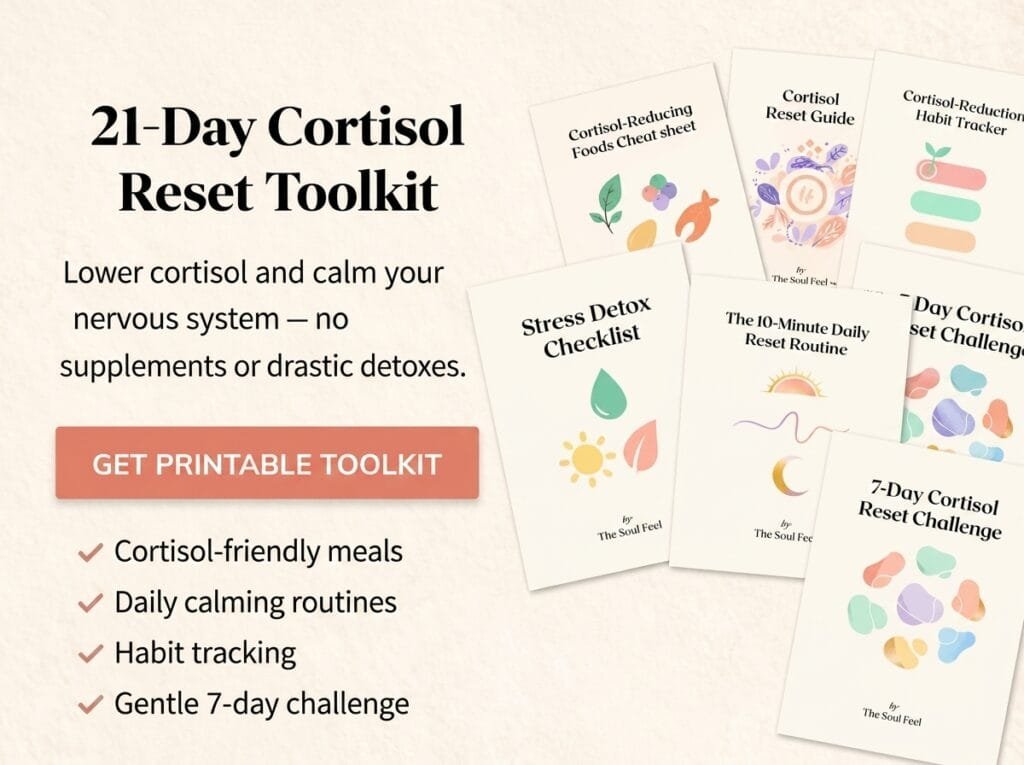
The 21-Day Cortisol Reset Toolkit was built for exactly this. It includes a 30+ page guide, a 7-day meal plan, daily habit tracker, stress detox checklist, and a complete reset routine — all as an instant printable download. No supplements. No overwhelm. Just gentle, realistic steps that fit into real life.
You’ve been carrying a lot. For a long time, maybe.
These exercises aren’t a magic fix — nothing real ever is. But they’re a doorway. A way of saying to your body: I see you. I’m listening. We can put this down now.
That’s not small. That’s everything.
With love,
As always, please consult with your healthcare provider for guidance personalized to your unique situation and history.