
For a long time, my days felt like a blur.
I dragged myself through mornings.
Relied on caffeine to function.
Then night would come… and suddenly I was wide awake.
My mind wouldn’t shut off.
My body felt tired, but restless.
Sleep felt shallow — or impossible.
I thought it was insomnia.
Or anxiety.
Or stress I just needed to “manage better.”
It wasn’t.
If This Is You, Read This Slowly
If you feel:
- exhausted during the day
- alert or restless at night
- tired but wired
- sleepy but unable to relax
This pattern is not random.
It’s often a sign that your cortisol rhythm is off.
Quick Support (For Skimmers)
When this pattern kept repeating for me, I realized my body needed regulation, not discipline.
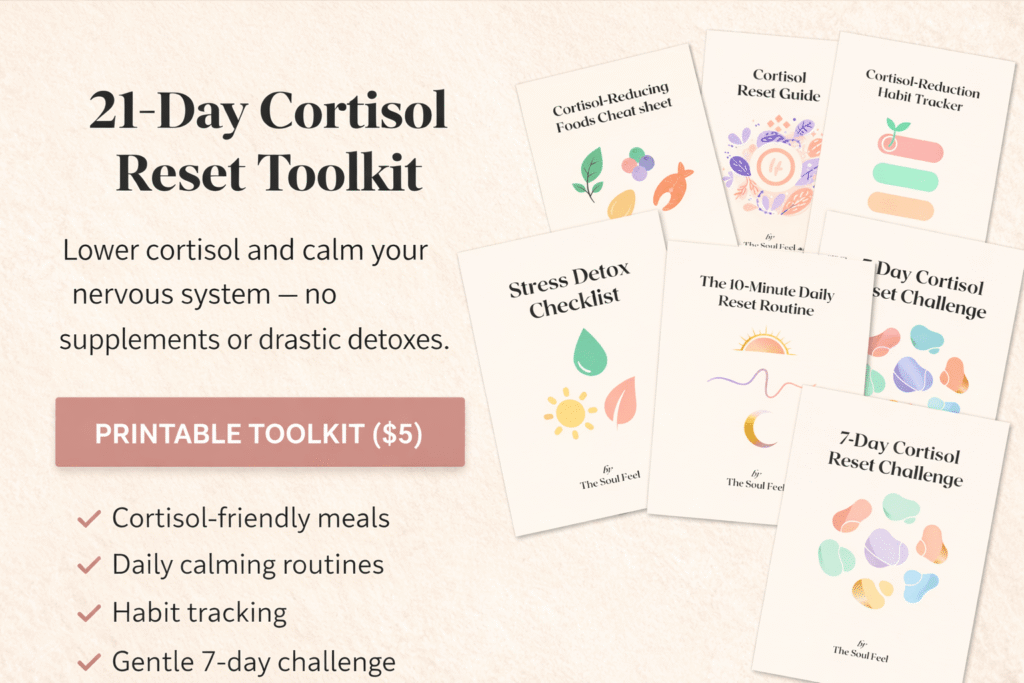
That’s why I later created a gentle 👉 21-Day Cortisol Reset Toolkit — to help calm stress hormones using food timing, simple routines, and nervous-system support (no supplements, no extremes).
You don’t need it to understand this article — but if you want structure, it’s there.
Now let’s break this down simply.
What’s Supposed to Happen With Cortisol
Cortisol follows a daily rhythm.
In a healthy pattern:
- Cortisol rises in the morning → you wake up
- It slowly drops throughout the day
- It’s lowest at night → you sleep
That rise-and-fall is what makes you feel:
- alert in the morning
- calm in the evening
What Happens When Stress Becomes Constant
Chronic stress — emotional, mental, physical — confuses this rhythm.
Instead of following the natural curve:
- cortisol stays elevated
- or spikes at the wrong times
- or crashes when you actually need energy
So your body ends up:
- tired when it should be alert
- alert when it should be resting
That’s the tired-but-wired feeling.
Why “Just Sleep Earlier” Doesn’t Work
This is where a lot of advice fails.
When cortisol is high at night:
- your nervous system is still on alert
- your body doesn’t feel safe enough to rest
- forcing sleep only creates more frustration
So you lie there:
- exhausted
- mentally quiet
- but physically awake
That’s not a mindset problem.
That’s a biological stress response.
The Shift That Helped Me Sleep Again
The biggest change wasn’t bedtime.
It was how I treated my body during the day.
I stopped trying to “knock myself out” at night and started:
- stabilizing mornings
- lowering stimulation in the afternoon
- giving my nervous system predictable signals
Sleep followed — slowly, gently, naturally.
What Actually Helped Calm Nighttime Cortisol
Here are a few shifts that made a difference for me:
- eating earlier, balanced dinners instead of late restrictive meals
- dimming lights and reducing stimulation before bed
- avoiding intense workouts late in the day
- creating a short, repeatable wind-down routine
None of this was extreme.
But it told my body: you’re safe now.
This same logic is what I later built into my Cortisol Reset Toolkit — because stressed bodies don’t need complicated plans, they need consistency.
If Nights Are Your Hardest Time
Please don’t assume something is “wrong” with you.
When your body stays alert at night, it’s usually because it learned — at some point — that rest wasn’t safe.
That can be unlearned.
Gently.
Without pressure.
Without forcing.
A Kinder Way Forward
If you’re wired at night and exhausted during the day:
- stop blaming yourself
- stop pushing harder
- start supporting your stress rhythm
Whether you use my toolkit or simply begin noticing your patterns, the goal is the same:
👉 Help your body return to its natural rhythm.
That’s when sleep stops feeling like a fight.
Additional Support
If you want a simple, printable way to support cortisol balance over time, my 👉 21-Day Cortisol Reset Toolkit includes:
- gentle daily routines
- food timing guidance
- nervous system calming practices
- habit tracking for sleep, energy, and stress
Use it at your own pace.