
Have you ever felt your heart racing even though nothing “bad” is happening? Somatic exercises to reduce cortisol can shift that stuck feeling fast. I’ve been there too—knowing I’m safe but still feeling wired, tense, on edge. In this guide, I’ll show you a gentle, 10-minute flow that signals safety to your body so your stress hormones finally settle.
What Are Somatic Exercises to Reduce Cortisol?

Somatic exercises to reduce cortisol are gentle, body-based movements that calm your nervous system from the bottom up. They help you feel grounded again when your mind alone can’t do the job.
A helpful long-tail variation is somatic exercises for stress relief and cortisol balance.
These practices work because your body communicates safety through sensation—not logic.
Why Cortisol Spikes Happen (and Why It Matters)

Sometimes your body gets stuck in fight-or-flight long after the stress is gone. It’s your nervous system’s old survival programming trying to protect you.
Cortisol rises when the HPA axis (hypothalamus → pituitary → adrenals) believes you’re still in danger. Even tiny stressors—rushing, noise, tension—can keep it activated. That’s why somatic exercises to reduce cortisol matter so much. They interrupt this stress cascade and bring your body back into safety.
This is also why you can think you’re fine while your body says otherwise.
Best Somatic Exercises to Reduce Cortisol (10-Minute Flow)
1. Grounding Through Your Feet
This brings your body back into the present moment. Your brain relaxes when it feels stable and supported.
It works by boosting proprioception—your body’s “where am I?” sense—which sends safety signals up the vagus nerve.
Try this: Press your feet into the floor and breathe slowly for 60 seconds.
2. Vagus Nerve Breath (Extended Exhale)
Long exhales calm the sympathetic nervous system and slow your heart rate.
It’s simple. It works quickly. And it helps cortisol drop fast.
Try this: Inhale 4 seconds. Exhale 6–8 seconds. Repeat six times.
3. Neurogenic Shake

Animals tremble after stress to release built-up tension. Humans benefit from this too.
Shaking relaxes the muscles and signals the nervous system that the danger has passed.
Try this: Shake arms, shoulders, and legs with soft knees for 1–2 minutes.
4. Diaphragm Release
Your diaphragm holds stress during fight-or-flight. Loosening it helps return the body to rest-and-digest.
Even a tiny release can shift your whole mood.
Try this: Place hands on ribs, inhale wide, exhale fully, soften belly. Repeat 30–60 seconds.
5. Butterfly Hold (Safe Touch)
This activates the ventral vagal system—the part of your nervous system linked to safety and connection.
It’s especially grounding during overwhelm or spirals of stress.
Try this: Cross arms over chest and tap right–left–right–left slowly for 1–2 minutes.
A Gentle Support You Might Love

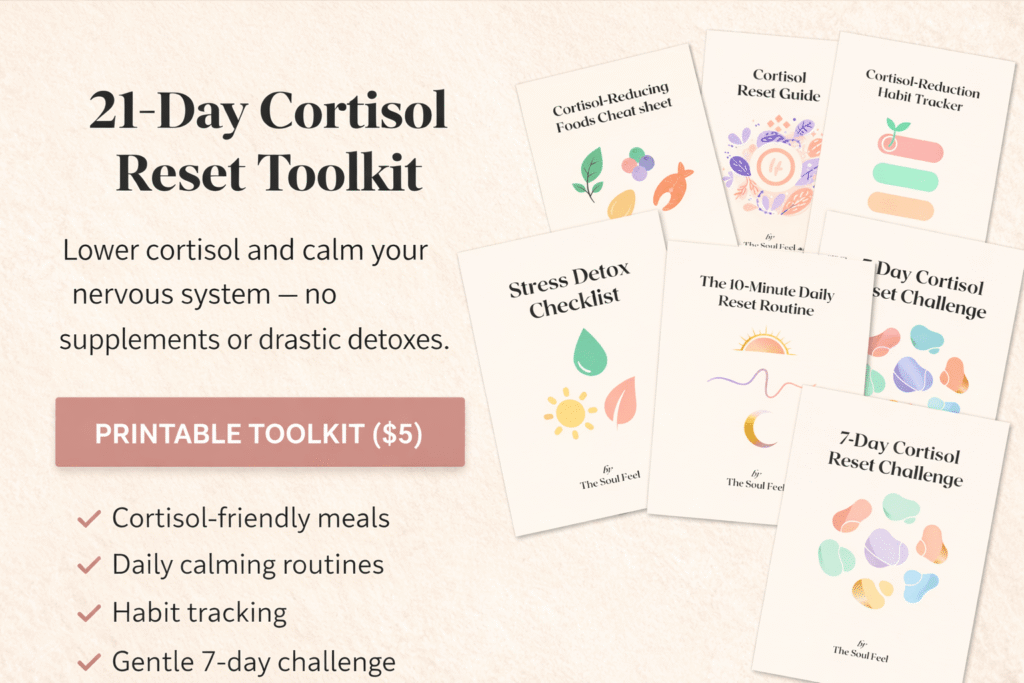
If you want a simple plan to keep your stress hormones steady, you may love the 21-Day Cortisol Reset Toolkit.
21-Day Cortisol Reset Toolkit for Stress Relief & Hormone Balance
It’s soft, beginner-friendly, and helpful if you’re tired-but-wired, overwhelmed, or sensitive to stress.
Inside you’ll find:
- A 30+ page cortisol guide
- A 7-day meal plan
- Cortisol-lowering foods cheatsheet
- A 10-minute daily reset routine
- Habit tracker
- Printable detox checklist
- A full 7-day challenge
It helps you feel calmer by day 7 and more regulated by day 21—without supplements.
How to Start Today

Begin with small steps.
- Do the 10-minute somatic flow once today.
- Add one long-exhale breath before meals.
- Shake out tension when you feel overloaded.
- Ground your feet when your mind spirals.
These tiny shifts work quickly.
Quick Answer
Somatic exercises to reduce cortisol work by calming the nervous system through grounding, shaking, breathwork, and gentle pressure techniques. These movements send safety signals through the vagus nerve, reducing sympathetic activation and helping the HPA axis rebalance. A simple 10-minute routine can ease stress and bring the body out of fight-or-flight.
Conclusion
Somatic exercises to reduce cortisol offer a gentle, science-backed way to soothe your stress hormones without forcing calm. A few minutes of grounding, shaking, breathwork, and soft touch can shift your entire day. Try the 10-minute routine today—and consider the Cortisol Reset Toolkit if you want steady support. Check with your healthcare provider for personalized advice.